

DON'T SEND IT DOWN
AI adoption isn’t stalling because of technology. It’s stalling because of leadership. Leaders set high level expectations, buy the enterprise license, and step back. Mandates are sent down without the required strategy, skills or resources. Middle management is left to interpret the “why,” while teams scramble to figure out the “how”.
By the time it becomes clear it isn’t working, months have passed and adoption is patchy, inconsistent, and the promised benefits have not been realised.
BCG estimates that only 20% of AI implementation challenges stem from the tech; 70% relate to people and process. A Harvard Business Review found that 92% of C-suite executives feel confident about AI’s impact, while 57% of practitioners say leadership doesn’t understand the realities they face.
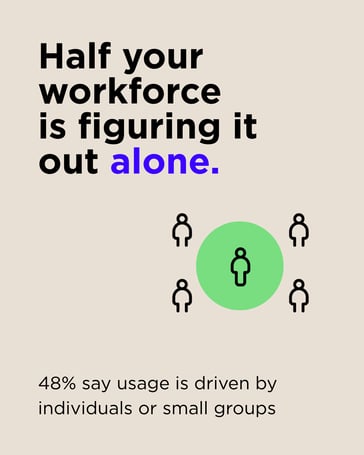
Our own Makers Engineering survey found that while 97% of engineers are using AI, 48% say usage is driven by individuals or small informal groups rather than leadership. Only 10% are spending more time on higher-level work like planning or design. 46% say the impact of AI isn’t formally measured or discussed at all.
Half the workforce is figuring this out on their own. Almost no one has structured support. And in nearly half of organisations, leadership isn’t even tracking what’s happening.
PLACE BETS AND BUILD INFRASTRUCTURE
Leaders who get this right don’t just issue mandates. They show up in the transition.
They set the vision, not just the directive, clarifying where AI creates genuine value, where it doesn’t, and what success looks like beyond “we’re using AI now.” They understand that AI needs to power the business if the business is to win, that if the business doesn’t become more successful as AI becomes more capable, it is fighting a losing battle. And they understand that in a world of limitless intelligence, company moats are different. Nothing is more important than proprietary and well structured data, interpersonal relationships - a smart AI-first culture.
.jpg?width=500&height=333&name=Claudia%20Harris%20(1).jpg)
Claudia Harris, Chief Executive Officer, put it simply:
"Great leaders role-model experimentation. They realise that cultures only change when people see leaders truly role- modelling in public. Trying things, failing, and learning visibly. Culture doesn’t shift when people receive a policy document about experimentation."
Leaders build the conditions for success rather than simply applying pressure: clear guidelines, procurement support and space for ideas to surface at every level. Powerful cycles where teams can escalate AI use cases up and understand leadership’s top down vision. Clarity on which parts of the business can tolerate more or less AI risk, and clarity on how to decide.
Critically, they set out what quality looks like and the ethical bar for their company. They understand that AI is built from the internet and that they need a profoundly different ethical framework for their own company.
A NEW FORM OF HUMAN INTELLIGENCE
There’s something that doesn’t get talked about enough: the new AI resistance movement that is quietly dominating companies.
People feel grief, that the skills they have built over 20 years are no longer needed. They fear that by adopting these tools they are turkeys voting for Christmas.
They don’t know how to use the tools. It’s a complete change in how they spend the 9 to 5 and a little bit of online training won’t cut it.
Many companies claim to have a learning culture. They don’t. Learning is hard. It takes the humility to stop doing what you did before, the insight to know you are not stupid - it is just new, and the grit to keep going when it gets hard. It takes the ability to deal with your prior learning experiences - devastation from a difficult schooling experience or the fear of failure from being the A* child to nervous parents. To help people learn - really learn, shedding all those barriers - companies need to address these challenges and support people. They need to lean into the grief and fear people are suffering.
They need to acknowledge it, create space for it. Be as transparent as possible about their headcount plans. They need to create a genuine learning culture. The psychological safety for people to try new things, an experimental culture that applauds experiments that fail as well as those that work (as providing useful new information) and the emotional support to keep people going when learning gets tough.
At Makers we have a chief Joy Officer. Building a learning culture is quite simply our bread and butter. We love helping leadership teams solve this cultural conundrum.
 Dana Svoboda, Chief Joy Officer at Makers leading a meditation workshop for our learners
In the 1970s people thought of human intelligence in terms of IQ: cognitive excellence. In the 1990s this evolved to EQ: emotional and relational intelligence. It is our view at Makers that the most important form of intelligence in the AI age is LQ: the ability to learn and adapt fast. And that being able to communicate openly and build a real learning culture is now table stakes in the AI race.
THE FIRST STEP FOR ANY ORGANISATION
Skills England has introduced short, levy-funded apprenticeship units designed quickly to build critical capability. One of the first is AI Leadership. The questions it addresses are the ones leaders are actually wrestling with:
How do we govern AI use without strangling experimentation?
What does ethical AI actually mean for procurement decisions?
Who owns AI risk, and what does oversight look like in practice?
How do we prepare for a regulation that doesn’t exist yet?
How do we turn AI adoption into something that genuinely transforms how the organisation performs?
This isn’t theory. It’s the operational literacy that turns mandate into execution.
WHY NOW?
The government has defunded 16 popular apprenticeship standards, including Team Leader and Chartered Manager, while opening levy funding to these new flexible units with no cap on employer spending. It’s a faster, more accessible route to building AI leadership capability than the system has ever offered. Organisations that act now will shape how AI is adopted in their industry. Those who wait will find themselves reacting to competitors, regulators, and a workforce that has already moved on.
Winning with AI isn't about who adopts it first. It's about who builds the leadership to actually see it through.
New government-funded apprenticeship units on AI Leadership have been announced. Get in touch to learn how to access Makers AI Leadership training.