
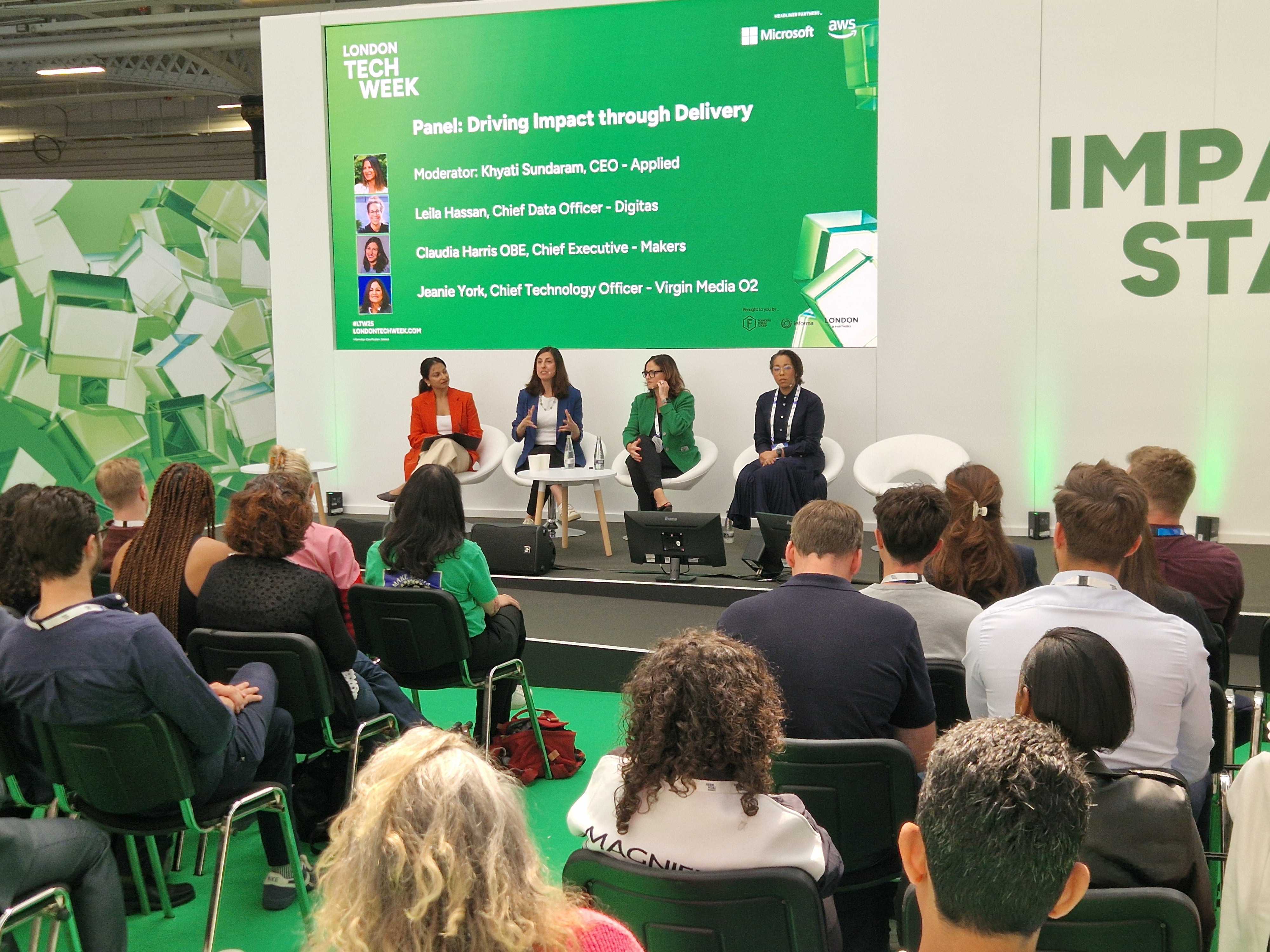
This time last year at London Tech Week, Claudia Harris OBE joined leaders from Digitas and Virgin Media O2 on stage to discuss driving impact through delivery. Shortly before, Keir Starmer had announced an ambitious pledge to partner with 11 major companies to train 7.5 million workers in AI by 2030, a signal that the UK was serious about leading on AI.
.png?width=1200&height=1200&name=Untitled%20design%20(70).png)
Claudia closed the session saying it felt like we were one minute into the first episode of a very long series and that some well-known brands were about to have their Kodak moment. A year on, both things feel more true now than they did then.
The gap between confidence and reality
It feels like the investment is real and AI is on every boardroom agenda. But here's what the headline numbers don't tell you.
92% of C-suite executives feel confident about AI's impact. 57% of practitioners say leadership doesn't understand the realities they face.
Training and adoption are not the same thing and a course completed is not capability built. A mandate sent down from the top, without the strategy, skills and culture to back it up, is how organisations end up with patchy adoption, frustrated teams, and AI that never quite delivers what it promised.
The dividing lines are not where you think
This is not a story about innovative industries versus traditional ones. The dividing lines are emerging between individual organisations, those with the vision and culture to move at pace and those still waiting to move.
What we see at Makers is that the companies making real progress share a few things in common. Their leaders show up in the transition by role-modelling, trying things, failing, and doing it all visibly. Because culture doesn't shift when people receive a policy document about experimentation.
They also acknowledge something that doesn't get talked about enough: the quiet AI resistance movement inside many organisations. People feel grief that the skills they have built over 20 years feel suddenly less relevant. They fear that by adopting these tools they are turkeys voting for Christmas. Effective leaders meet people where they are, fear and all, not just where they want them to be.
The most important intelligence in the AI age
In the 1970s, human intelligence was measured by IQ, cognitive excellence. In the 1990s it evolved to EQ, emotional and relational intelligence. At Makers, we believe the most important form of intelligence in the AI age is LQ: the ability to learn, unlearn and relearn fast. And that building a genuine learning culture is now table stakes in the AI race.
The organisations winning right now aren't running a bit of online learning. They are embedding new routines, building psychological safety for people to experiment and creating powerful feedback loops where teams can surface AI use cases up. The leaders set the pace, the broader team reimagines how work gets done and the engineers build the spine.
What comes next
For the most part the ambition is right. But the question worth asking isn't how many people have been through a training programme, It's how many have genuinely changed the way they work.
The organisations that get this right won't be the ones that buy the best tools. They'll be the ones that build the most fearless learners, at every level, from the boardroom to the broader team.
That's the harder problem to solve and it's the one we're already doing.